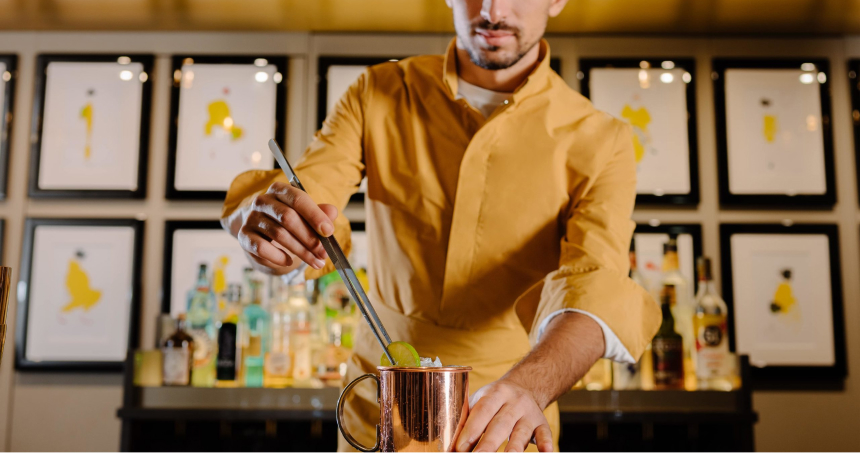
The bar in a luxury setting is an ecosystem of atmospheres, lighting, and precious materials. The design of a bartender uniform must not rely on aesthetic labels or fleeting trends, but must arise in profound harmony with the architectural style of the venue. At Maurel, we design uniforms capable of dialoguing with the ambient light, often dim, and with the materials that characterize the space, such as brass, marble, wood, or leather.
Uniform characteristics
Functional details and technical specifications
Our goal is to ensure absolute chromatic coherence with the counter, so that each project faithfully reflects the identity of the establishment. Our strength lies in design customization, not in the definition of rigid or standardized models. Behind the bar, elegance must merge with ergonomics.
The fit of our garments is specifically designed for the technical gesture: precise actions such as shaking or stirring require sleeves that never hinder the bartender's operations.
We select fabrics for the high-end hospitality world that guarantee authority, long-term stability, and ease of maintenance, avoiding the use of low-resistance fibers in favor of durable materials that withstand frequent washing well.
Structural resistance to friction: Those working behind a bar are constantly subject to friction against it. To solve this problem, we select durable fabrics that are less sensitive to stress, ensuring prolonged aesthetic stability over time.
Fluid Day/Night management: In a hotel, the bar changes rhythm and tone between the day (light, service, clientele) and the evening (dress code, signature cocktails). Aware of the difficulty of managing uniforms, we propose solutions that allow for changing the fewest elements possible. The transition can occur simply by changing a jacket or accessory, or by shifting from a lighter daytime palette to a deeper evening one.
Accessories as a common thread: Sartorial details and accessories, such as sleeve garters, suspenders, or bow ties, are often used to create a stylistic and visual link with the uniforms of other hotel departments.
Frequently asked questions
What are sleeve garters used for by a bartender? Sleeve garters are an essential functional accessory to keep cuffs away from liquids and ensure cleanliness during service.
Must a mixologist wear an apron? There is no absolute rule for this professional figure; the mixologist does not necessarily wear an apron.
What is the difference between a Bartender and a Mixologist? The Bartender is the service professional, responsible for beverage preparation, operational management of the bar, and the direct relationship with the client. The Mixologist is instead a figure more oriented towards research, creation, and the storytelling of the cocktail.
How does a professional Bartender dress? In the high-end hospitality sector, there are no predefined standards, but the vest is undoubtedly the most iconic and widely used garment for this figure.
Contact us for
information
If you would like to get to know us better or learn more about our collections, please fill in the form with your details and your request: a member of our staff will contact you as soon as possible.